Change Impact
Predict the blast radius of every change.
Change a requirement, spec or part — see every affected test, FMEA, CAD assembly and release in seconds.

Context64.ai turns fragmented engineering systems into governed context — so engineers and AI can search, reason, and act with traceability.
Re-evaluate FMEA on the motor controller line.
Engineering knowledge is spread across PLM, CAD, ERP, requirements, test systems, documents, and supplier data. Context64 turns that fragmented landscape into a governed context graph that engineers and AI systems can search, reason over, and act on.
Your context becomes a durable company brain — portable across any model, no lock-in.
Governed, graph-scoped context instead of vague retrieval over document dumps.
Exactly tailored context per task — consistent quality at a fraction of the operational cost.
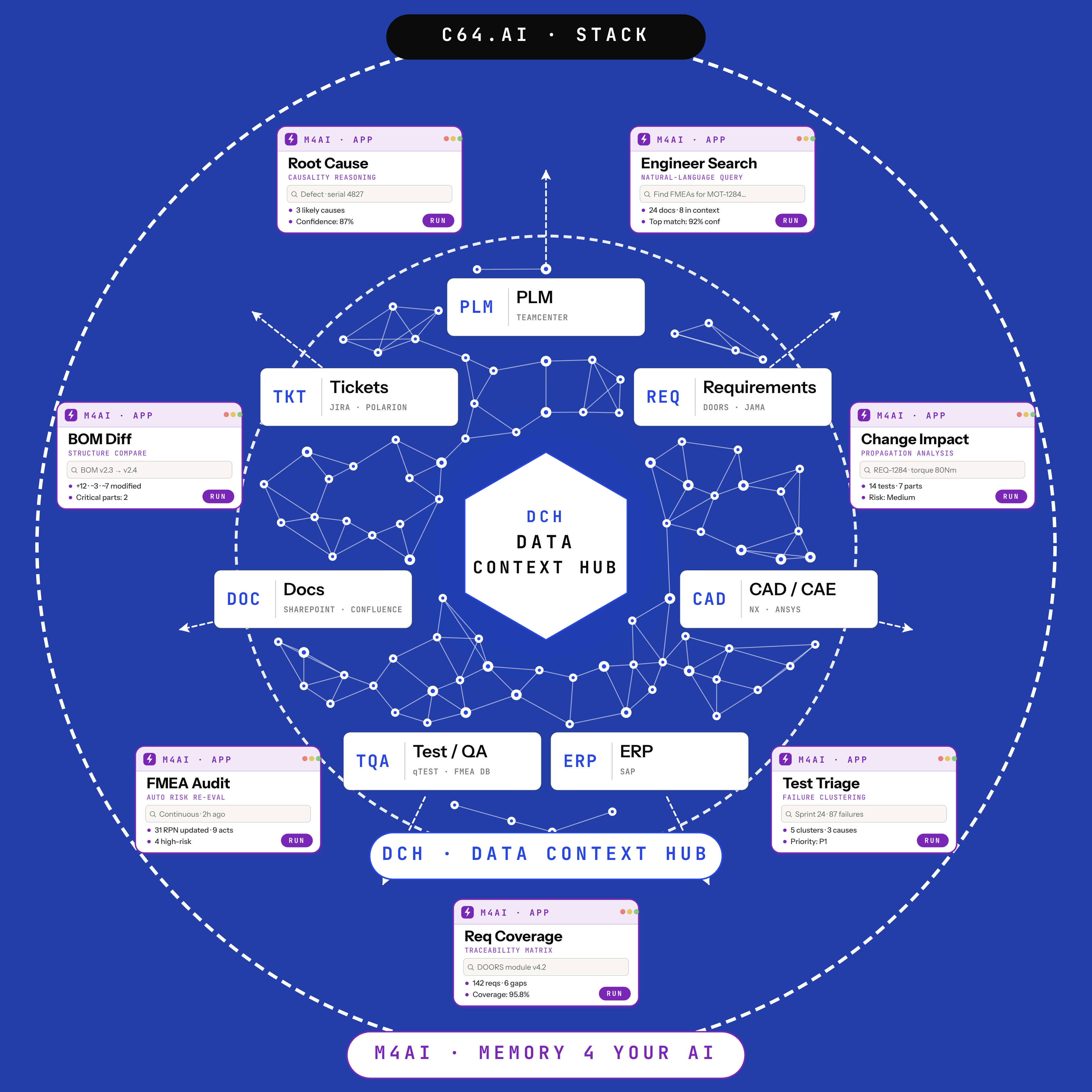
Intake → DCH → M4AI → Delivery — with C64 Studio as the workbench across the stack. DCH builds context, M4AI reasons over it, Studio helps build the applications and workflows that expose it wherever engineering work happens.
Connect any engineering source
Connect the systems, repositories, and workflows where engineering work already happens — PLM, CAD, requirements, tests, tickets, and documents.
Application workbench for creating tools, workflows, and engineering surfaces across the stack.
Use what we’ve prebuilt. Or compose your own using REST API, MCP, Studio Apps and embedded tools— all on the same Context Graph.
Predict the blast radius of every change.
Change a requirement, spec or part — see every affected test, FMEA, CAD assembly and release in seconds.
Every requirement, traced and evidenced.
Continuously map requirements to specs, tests and release evidence. Catch coverage gaps before audits do.
From bug ticket to root subsystem.
Trace field issues, test failures and tickets back to the responsible spec, component or design change — across your full engineering graph.
FMEAs that stay alive.
Validate FMEAs against real failure data, missing requirements and recent design changes. Flag gaps continuously.
Keep SysML models in lockstep with reality.
Continuously align SysML models, requirements and downstream artifacts. No more silent drift between architecture and implementation.
Reason across every product configuration.
Understand which change affects which variant, market or production line. Reason across complex configuration trees in real time.
Or let us build it with you.
Have a workflow that doesn’t fit a template? Compose it with Studio Apps, MCP and REST APIs — or partner with us to ship it.
Talk to engineeringOne Jira issue becomes source-linked context, a graph path, and multiple usable application outputs.
Co-developed and deployed with OEMs, suppliers, research organizations, and technology partners across engineering-heavy environments.


Connects engineering data, models the ontology, builds the context graph, and delivers precise, governed context on demand.
Build no-code agent systems on top of the DCH knowledge graph — the graph is their memory, scoped and governed.
A context graph connects engineering entities, relationships, versions, ownership, evidence, and dependencies across systems — modeling how engineering work actually relates: requirements to tests, components to changes, failures to mitigations.
RAG retrieves fragments. Context64.ai builds a governed context layer — agents and applications reason over entities, relationships, lineage, permissions, versions, and evidence, not only text chunks.
Data Context Hub builds and governs the context layer. Memory 4 Your AI uses that graph as memory for agent systems, letting teams build agents that reason over governed engineering context.
No. Context64.ai sits above existing systems and turns their data into a connected context layer. Teams keep using their current PLM, CAD, ALM, ERP, ticketing, document, and test systems.
Yes. It supports cloud, private cloud, on-prem, and controlled deployment models — including EU-sovereign and air-gapped variants where required.
Context64 AI turns fragmented engineering systems into governed context, so engineers and AI systems can search, reason, and act with traceability.
Can we approve this battery module change?
Engineering teams work across PLM, CAD, requirements, tests, tickets, documents, and approvals. The relationships matter most — but they are rarely available as usable context.
The information exists — but it's fragmented across systems, with no shared version, owner, or evidence. So the decision waits.
Engineering knowledge is spread across PLM, CAD, ERP, requirements, test systems, documents, and supplier data. Context64 turns that fragmented landscape into a governed context graph that engineers and AI systems can search, reason over, and act on.
Your context becomes a durable company brain — portable across any model, no lock-in.
Governed, graph-scoped context instead of vague retrieval over document dumps.
Exactly tailored context per task — consistent quality at a fraction of the operational cost.
Co-developed with leading OEMs, suppliers, research organizations, and technology partners across engineering-heavy environments.


A German OEM implemented a linked data layer that unified engineering knowledge across systems into a single contextual fabric, with a Knowledge Graph at the core.

Large engineering-driven enterprises generate massive volumes of operational and product data across vehicles, manufacturing systems, and simulations. IBM and Context64 make engineering data lakes usable.

Together with Emposo, Context64AI implemented TestForge — an AI-driven system that generates test cases directly from complex engineering inputs.

Engineering and service teams work with complex 3D assemblies made of thousands of parts. Context-aware engineering intelligence connects 3D models to the surrounding knowledge graph.

Virtual Vehicle is Europe’s largest R&D centre for virtual vehicle technology and the origin of Context64’s core knowledge graph work. Together they built an AI Knowledge Hub for engineering.
DCH makes organizational context operable. M4AI turns scoped context into intelligence. Studio helps teams build the applications, workflows, and tools that expose that intelligence wherever engineering work happens.
Connect systems, repositories, and workflows where engineering work already happens.
Build and govern the context graph that connects engineering entities, relationships, lineage, and permissions.
Turn scoped context into agent memory, reasoning, and multi-agent workflows.
Expose capabilities through custom UIs, MCP, REST APIs, embedded tools, Studio apps, and workflows.
Application workbench for creating tools, workflows, and engineering surfaces across the stack.
Use what we’ve prebuilt. Or compose your own using REST API, MCP, Studio Apps and embedded tools— all running on the same Context Graph.
Predict the blast radius of every change.
Change a requirement, spec or part — see every affected test, FMEA, CAD assembly and release in seconds.
Every requirement, traced and evidenced.
Continuously map requirements to specs, tests and release evidence. Catch coverage gaps before audits do.
From bug ticket to root subsystem.
Trace field issues, test failures and tickets back to the responsible spec, component or design change — across your full engineering graph.
FMEAs that stay alive.
Validate FMEAs against real failure data, missing requirements and recent design changes. Flag gaps continuously.
Keep SysML models in lockstep with reality.
Continuously align SysML models, requirements and downstream artifacts. No more silent drift between architecture and implementation.
Reason across every product configuration.
Understand which change affects which variant, market or production line. Reason across complex configuration trees in real time.
Or let us build it with you.
Have a workflow that doesn’t fit a template? Compose it with Studio Apps, MCP and REST APIs — or partner with us to ship it.
One Jira issue becomes source-linked context, a graph path, and multiple usable application outputs.
Perspectives from customers, partners, research collaborators, and advisors helping shape context-aware engineering AI.
The context problem of today’s LLMs is not a usage error — it is a systemic problem. Context64 does not solve it with ever-larger models, more tokens, and more agents, but the other way around: through precise control of the context the models work with. Instead of letting the model puzzle over a vague, enormous context, the platform delivers exactly tailored context for every task. The result: consistent quality at a fraction of the operational cost.
From a single part selection in the PDM system, Context64 pulls the full engineering chain across Teamcenter, DOORS, JIRA and SAP — down to the line in all production facilities.
Decades of research only create value when engineers can find and apply them. With Context64, our project knowledge becomes a living graph that researchers and vehicle programs can actually query.
Together with Context64.ai, we bring AI to where it truly matters: into the daily work of development organizations. Less PowerPoint, more measurable impact — faster, scalable, and sustainable.
Short answers to the questions engineering, data, and AI teams usually ask when evaluating Context64.ai.
A context graph connects engineering entities, relationships, versions, ownership, evidence, and dependencies across systems. Instead of treating data as isolated files or records, it models how engineering work actually relates: requirements to tests, components to changes, failures to mitigations, documents to decisions, and owners to workflows.
Talk to the team. We'll walk you through how Context64.ai fits your engineering environment.
Ask your assistant of choice how Context64.ai turns fragmented engineering systems into a governed context layer — connected, versioned, and traceable across design, engineering, production, and service organizations.