



As organizations push AI deeper into engineering and product workflows, one lesson becomes clearer every year: intelligence requires structure. Models alone cannot deliver reliable outcomes without an underlying system that governs context, data, orchestration, and reasoning.
With DCH 3.0, the platform evolves into a far more unified and mature intelligence environment. This release is not just a feature update it is a significant architectural step that strengthens how DCH and M4AI operate together as a single, cohesive platform.
A Unified, Next-Generation DCH UI
Previous versions of the platform relied on two separate surfaces the GBS UI for system and workflow management, and the Explorer UI for graph navigation. Both were tied to older interaction patterns and legacy v1 endpoints.
DCH 3.0 introduces a new, next-generation DCH UI, built on modern v2 APIs and redesigned around the full operational lifecycle of the platform. This is not the combination of old interfaces; it is a complete rethinking of how users interact with the system.
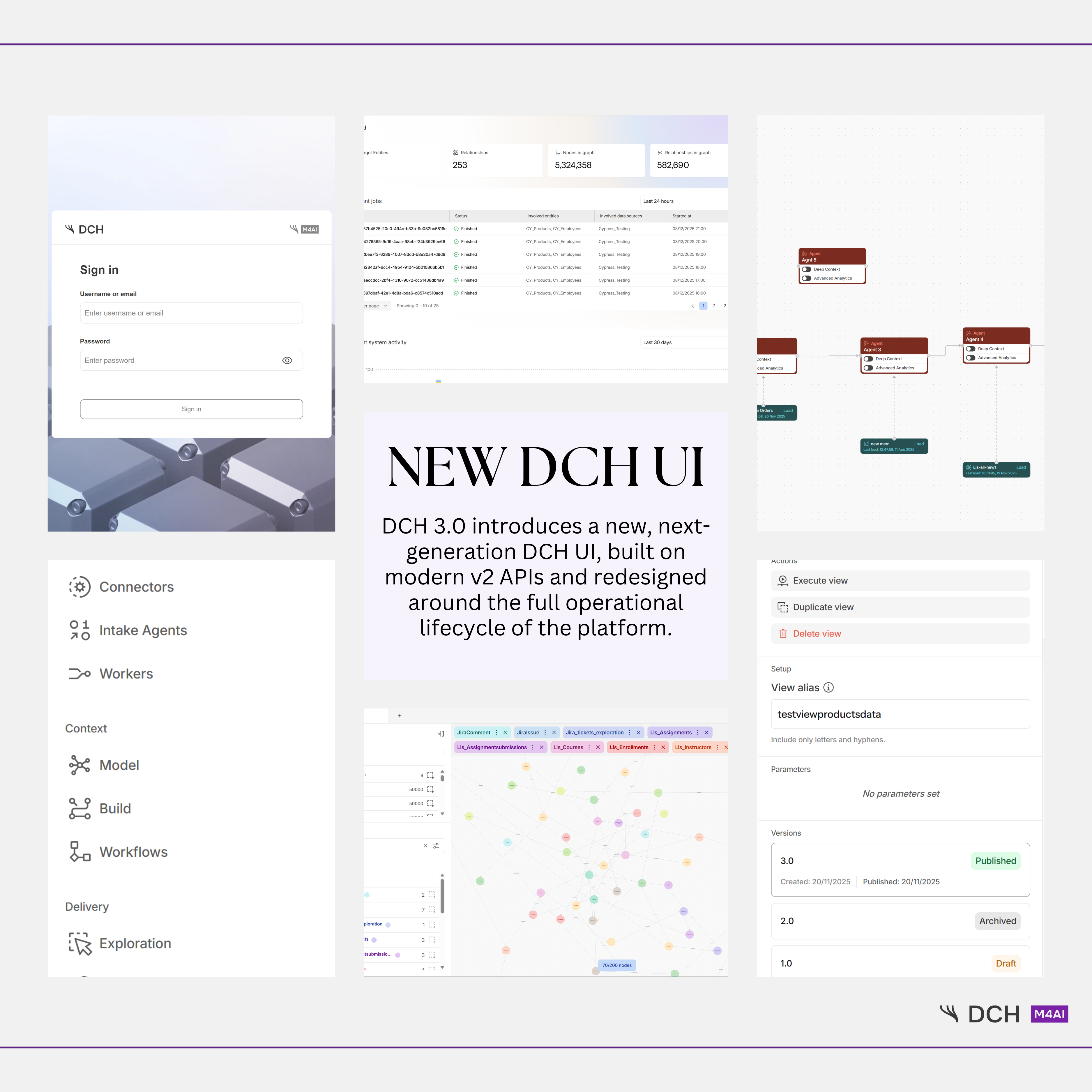
The new DCH UI becomes the central operational portal for the entire platform:
- graph exploration and modelling
- projections (views + functions)
- workflows and orchestration
- ingestion via intake agents
- service and worker monitoring
- reasoning traces and M4AI execution visibility
It provides a coherent visual language, consistent patterns, and real-time insight into how data, memory, and reasoning flow through the platform.
The result is a UI that matches the architecture: modern, integrated, and aligned with how DCH and M4AI work today not how earlier systems worked.
DCH + M4AI: Two Engines, One Intelligence System
At the architectural level, DCH 3.0 strengthens the separation of responsibilities while improving how the two engines collaborate.
- DCH governs orchestration, graph operations, lifecycle management, data shaping, observability, and ingestion.
- M4AI handles agent execution, contextual reasoning, action handling, and streaming output.
DCH provides the structured, versioned context.
M4AI reasons on top of that context.
This alignment turns the platform into a synchronized intelligence engine, where every part of the pipeline is controlled, observable, and built on the same lifecycle rules.
Projections: A Unified, Versioned Data-Shaping Layer
One of the most important upgrades in 3.0 is the introduction of Projections, which unify Views and Functions under a single, governed model.
Projections offer:
- a consistent data-shaping layer for graph access
- full versioning (draft → test → publish → archive)
- built-in testing and validation
- seamless integration with the Linked Data API
- reliable, stable context surfaces for M4AI agents
Projections formalize how organizational knowledge is delivered to reasoning systems, making the interface between graph and agents significantly more robust.
Workflows: Modern Orchestration for the Entire Data & Memory Pipeline
.png)
Workflows replace Load Plans with a modern execution layer that manages:
- ingestion routines
- graph builds
- memory reload operations
- rule transformation steps
- scheduled and triggered workflows
Everything runs within the same versioned lifecycle as projections and agents.
This brings orchestration, data preparation, and memory management into a unified model fully visible and controllable from the DCH UI.
Clear Architectural Boundaries Across the Platform
DCH 3.0 introduces explicit, stable boundaries across the major subsystems:
- Linked Data API → the backbone for graph and data operations
- M4AI → the backend for agent reasoning and memory
- DCH → the operational and orchestration layer that ties everything together
This clarity allows each subsystem to evolve independently while maintaining a consistent interaction model across the platform.
It also simplifies onboarding, documentation, and integration for enterprise teams.
Intake Agents: A Dedicated Ingestion Tier
In previous versions, ingestion logic was implicit inside Worker services.
DCH 3.0 formalizes ingestion as its own subsystem: Intake Agents.
Intake Agents provide:
- clear definitions of how external data enters the system
- structured flows into graph and memory
- dedicated configuration and monitoring UI
- improved reliability and observability
This upgrade lays the foundation for advanced ingestion pipelines, connectors, validations, and domain-specific data processing.
A Platform-Wide Versioning Model
A major theme of DCH 3.0 is lifecycle consistency.
Now, all core intelligence artifacts follow the same lifecycle:
draft → test → publish → archive
.png)
This applies to:
- projections
- workflows
- M4AI agents
The platform becomes easier to audit, govern, and operate especially in enterprise environments where traceability and reproducibility matter.
Transparent, End-to-End Intelligence Flows
With the new DCH UI and consolidated orchestration model, the entire intelligence pipeline becomes visible:
ingestion → graph → projections → memory → agents → results
Every stage is observable, versioned, and controlled.
Teams can see how data moves, how context is shaped, and how reasoning unfolds.
This transparency is core to building trustworthy AI systems.
From Separate Components to a Cohesive Intelligence Engine
DCH 3.0 marks a turning point.
What used to operate as multiple powerful but independent components now functions as one unified intelligence platform:
- DCH manages structure, context, orchestration, and visibility
- M4AI executes reasoning and actions
- Every part of the system follows the same lifecycle and governance model
- The new DCH UI becomes the operational home for the entire pipeline
The platform is now architected for the next decade scalable, governed, explainable, and deeply integrated.